By DAVE O’SULLIVAN
Publisher
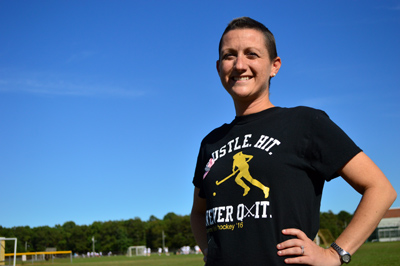
One day, when Denise Murray was 13 years old, she boasted to her father, John, that she was getting some rock-hard abs. During the next few days, her stomach began to swell, and John Murray knew something definitely wasn’t right. He took his daughter to the doctor, who realized there was a big problem and sent the Murrays up to Children’s Hospital of Philadelphia. It was discovered that Denise had a cancerous tumor the size of a grapefruit around her ovaries.
“I was diagnosed my eighth-grade year with Burkitt Lymphoma, which is a fast-growing tumor. It’s very rare in the United States, and rare in females, so we don’t know where it came from,” Denise said. “The crazy thing is, it didn’t make me sick. It just grew rapidly. It almost made me look like I was pregnant over the span of just a few days. At first, we just thought it was muscle because my stomach got really hard. Then, all of a sudden, my pants wouldn’t fit. So we went and got it checked and the doctor knew it wasn’t normal, so we went right up to CHOP and they did emergency surgery.”
Denise, in time, made a full recovery. She even played her freshman year of field hockey at Absegami despite having to go through chemotherapy and radiation treatment. Teenagers bounce back pretty quickly from adversity, and Denise went on to have an outstanding career as a field hockey and track athlete for the Braves.
All good, right?
Fast-forward to January 2016. A now 31-year-old Denise Murray couldn’t believe the news. She had another life hurdle threatening to trip her up. She had cancer. Again. This time, it was breast cancer.
“There are some teachers in the building who are still here and were here when I went through (cancer) the first time. One of the hardest things last January, when I was diagnosed (with breast cancer), was having to tell everybody that we had to go through this again,” Denise said. “We went through a lot of testing, and they couldn’t relate the two cancers. The only silver lining is I knew what to expect, so I wasn’t going in blind. How I try to think about it is that I’d rather go in knowing what I’m up against than somebody going through it for the first time. That’s how I dealt with getting cancer again. You absolutely think, ‘why me?’ But because of the way my parents handled it the first time, I didn’t think of it as a terminal disease. The mindset I had from having it previously was that I was going to beat this, I just had to figure out the steps I needed to go through and make sure I kept my body as healthy as possible. I knew it was going to be annoying (adhering to a strict diet) and that it would be a pain, but it was something I had to fight through and hopefully come out on the other side a better person.”
“The second time it really hit us hard, but knowing her strength of character, it made it easier because she is very tough. She’s an inspiration to us because of her toughness,” John said. “She has three sisters, Melissa, Jeanna and Lauren, and they are all tough kids. Even when she was going through chemo, we knew she was hurting inside, but she never showed it. She really just said, ‘I’m not going to let this get me down.’ And she overcame it.”
Denise said she wasn’t sure if she could continue to coach after going through intense chemotherapy in April, but by the summer she was feeling well enough to return to the field. She almost needed to be back out there, she said, as her own form of therapy.
“When I met with the girls, I told them I would be a part of the team in some respect. I didn’t know if I would be able to be the head coach. But we’ve established a program and we want to see it through. My assistants are amazing and we are all very close, so I knew I had that support. The truth of it is, (field hockey) is a distraction. When I’m out on the field with the girls, I forget that I have cancer. Being so non-stop with school and field hockey has helped me keep my life somewhat normal despite the reality,” Denise said. “The nice thing is, it didn’t happen in the middle of the season. I told the field hockey girls before I told anyone on the Absegami staff because I didn’t want them to hear from anyone but me. The nice thing is, thankfully, through this whole thing, I have been able to stay positive and I don’t look sick all the time. I wanted them to see me and know that I was going to be OK rather than hear from somebody else and think the worst. We met, and it was emotional, but when I’m out on the field we don’t talk about it. And I think because my focus is on field hockey, their focus in on field hockey as well. They don’t see me upset or sick, they just see their coach out on the field trying to make them better players.
“Part of the reason I kept coaching was because it gave me a purpose. I didn’t want the person they have always known to change in their mind. So being involved in field hockey has made this so much easier for me. I’m not sitting at home feeling sorry for myself.”
“She stays really happy. She tries to keep us out of it, for the most part, but she keeps us updated. We were all shocked (when we found out) because we all knew what she went through when she was younger. We all tried to stay happy for her and keep our minds on trying to do better for her,” said senior captain Lauren Houf. “She’s always been upbeat, positive and happy. That makes us want to do better and keeps us happy. She’s really inspiring. She’s always been out here, even when she was sick she would come out for a little while. She stays positive, no matter what, and that keeps us going.”
John said that as much as the team has relied on his daughter to lead the way, she’s relied just as much on her players to help her get through one of the most difficult challenges of her life.
“Having sisters and a strong family, and being involved at Absegami with teaching and coaching, I think that really helped keep her focused on something other than the cancer,” he said. “In the beginning of the season, when we were in those summer practices, I told the girls that we have no business complaining. Seeing her work as hard as she was in that heat after just getting through chemo. We had no complaints all summer long. The team just worked so hard.”
It has been tough on John, he said, because Denise is no longer 13 years old. She has a husband, John Ball, and her own life. She has to tackle this in her own way, which hasn’t been easy for John and wife Diane to handle. As parents, they spent many years used to being there for all of Denise’s needs.
“The first time, we were the caregivers, so we were there all the time. But she’s married now and has a life of her own, so it’s been quite difficult to stand on the sidelines and let her deal with this. We’re always there to support, but she wants to deal with it as an adult, which is tough for me,” John said. “But we are so proud of her. Even when she could take days off, she didn’t. Other teachers at Absegami would tell her, ‘why don’t you just take a day off?’ But she’s so dedicated to her students, and that makes us so proud. Her mother and I are both educators, so that certainly makes us proud.”
“When I was a kid, my No. 1 job is just to get better so you can go back to school. Now, I’m married, there are things to do around the house. My husband has been wonderful, but I do have responsibilities,” Denise said. “And it’s the same thing (at Absegami). The people have been wonderful and will bend over backwards to help me, but there’s a personal responsibility I have to work through it. When I’m home, I feel like I should be doing things instead of just resting. I struggle with that a little bit. I don’t want to be sick. I want to be doing things. Being an athlete, I’m so used to being able to run and do things, but now if I do just a few things at practice, I’m tired the next day. But, in the breast cancer world, I’m very young.”
Pink games, when players wear pink uniforms or hair ribbons, or socks, have gained in popularity throughout the past several years. Players try to raise money for cancer research, and Denise said her players now have the opportunity to see why so many schools have championed this cause.
“All of this awareness — and, more importantly, the money that has been raised for research — I’ve benefitted from. I was put on an alternative treatment that just got approved two years ago, so I tell the kids that this is where all the money is going,” Denise said. “All of the money that is going to research, I’m now somebody who is seeing the benefits of that. So it’s cool for the kids to understand that it’s really working and that advancements in medicine are happening quickly. There’s a personal connection to it now. When they are wearing pink, it means something to them.”
Some may call Denise hard-headed for trying to take on so much while going through breast cancer. She rarely takes a day off and is there for her field hockey players every day. She gets that kind of drive from her father, who was a longtime girls basketball and track coach at Absegami and who now, even in retirement, is part of the field hockey coaching staff. She gets the tough love from John, and a little bit of nurturing when she needs it from Diane.
“One of the greatest compliments I get here is that I’m just like my dad. I think I am who I am because of my dad and mom. To hear that I inspire him is kind of weird because it’s always been the other way around,” Denise said. “And my mom has been amazing. She’s been the nurturer, where as my dad is kind of the tough guy. I’ve been on a very strict diet and my dad is very watchful of that, but sometimes I just wanted a cookie. And my mom would be like, ‘John, just let her have a cookie.’”
Denise said going through breast cancer is an ordeal that she has to go through, but something that affects a lot of other people around her. She knows this, and she is quick to give credit where credit is due.
“What people don’t realize is that while it’s awful for the person going through cancer, it’s just as bad for the people who are close to them. Something my family and my husband deal with that people don’t realize is that most people see the cheery, happy Denise who is always doing well. They get to see the sick Denise who is home throwing up,” Denise said. “So, sometimes that takes a stronger person than the person going through cancer to be able to deal with that and be there for that person and keep them positive. It’s not always rainbows and unicorns. My family and husband have been amazing in providing that support.
“I think how I’ve been able to deal with it is a complete tribute to my parents. Cancer has, unfortunately, become a lot more common. After the first time, when we talked about all the things that could go wrong, we never looked back. We were going to beat this. And when I got it again, it was the same thing. We didn’t dwell on the negative, it was just ‘what do I have to do to get out of this as best I can?’ With the teachers here, when I had to tell them we had to go through this again, their response was that if it had to happen to someone, I’m someone who can deal with it and get through it. So that gives me some confidence that there isn’t anything we can’t beat. I don’t do it by myself. My husband is wonderful, my family is wonderful. And being at Absegami, I couldn’t ask to go through it at a better place. This is home for me. If I have to go through some bad times, this is the community I want to be around.”
Absegami is having a pretty good season, and has a shot to make the state playoffs. But John said the Braves’ final record won’t matter to the girls on this team. They’ve learned something much more valuable than stick skills this season.
“The friendships they make out here, the connections they make with Denise, it makes them a more cohesive group. And that’s going to do nothing but benefit them,” John said. “The season, who knows if we’ll finish with a winning record. But you don’t remember those things. You remember the friends you made and the inspiration of your coaches.”
Contact Dave O’Sullivan: sully@acglorydays.com; on Twitter @GDsullysays
Absegami field hockey coach Denise Murray won’t let breast cancer stop her from doing what she loves